How We Built an AI Copilot That Converts n8n Workflows into ByteChef Workflows
On this page
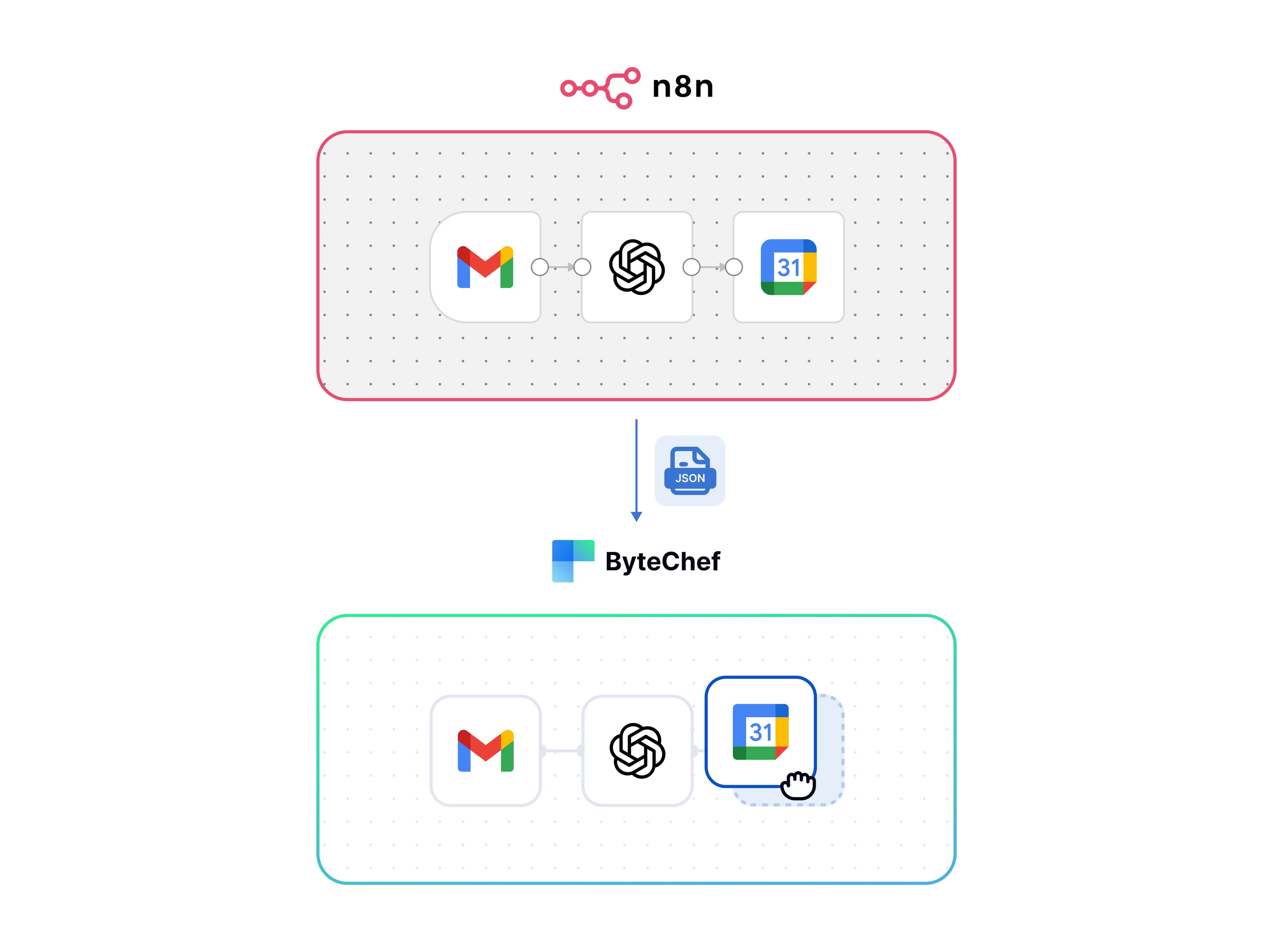
TL;DR: We built an AI-powered n8n importer for ByteChef and learned that converting workflows between automation platforms is way harder than just generating JSON.
LLMs are surprisingly good at understanding workflow intent, but reliability only comes from the systems around the model - validation, retries, graph rules, and semantic checks. The bigger realization was that workflow portability is becoming a real problem as automations turn into operational infrastructure, and AI can help make interoperability between platforms actually practical.
Bottom line: AI generation is the easy part - making workflows actually portable and reliable across platforms is the real engineering challenge.
Why We Built This
One thing we kept hearing from people evaluating ByteChef was:
“We already have a lot of workflows in n8n.”
And honestly, that’s fair.
Even if someone likes your platform more, nobody wants to spend days or weeks rebuilding automations they already have working somewhere else.
If you’ve ever migrated automation platforms before, you know how painful it is:
- export workflow JSON
- recreate triggers manually
- reconnect APIs
- rewrite conditions
- fix expressions
- rebuild loops and branches
- debug weird edge cases all over again
It’s not hard in an intellectually interesting way. It’s just tedious.
And for teams with dozens or hundreds of workflows, migration becomes the main reason they never switch at all.
So internally we started asking:
Could we just take an n8n workflow JSON file and convert it directly into a ByteChef workflow?
At first this sounded a little insane.
Workflows are not just JSON blobs. They encode:
- execution graphs
- branching behavior
- loops
- expressions
- node semantics
- platform-specific assumptions
Two workflows can look almost identical structurally while behaving completely differently at runtime.
Still, we decided to try.
And honestly, the results surprised us.
The Part That Surprised Us
We started with a very simple idea:
- upload n8n JSON
- let an LLM figure out the ByteChef equivalent
- validate the output
- retry if necessary
No complicated compiler.
No AST pipeline.
No intermediate representation.
Just prompts, validation, retries, and a lot of experimentation.
The first workflow that made us stop and go:
“Wait… this actually works”
was a GitHub → Slack reminder workflow.
Nothing too fancy:
- fetch assigned GitHub issues
- send Slack reminders to work on them
We expected the parameter mapping to completely fall apart.
Instead, Claude managed to:
- reconstruct the execution flow
- understand the integrations
- preserve the workflow intent
- map parameters correctly enough for the workflow to actually work
That was the moment we realized this might be much more viable than we initially thought.
What surprised us most wasn’t the JSON generation itself.
It was the semantic understanding.
The model was often surprisingly good at figuring out:
“This n8n node doesn’t exist in ByteChef, but this other component is functionally equivalent.”
That part felt borderline magical sometimes.
But Things Broke Very Quickly Too
Once workflows became more complex, the cracks started showing.
The hardest problems were never syntax problems.
They were execution semantics problems.
One of the first workflows that failed badly had:
- a condition node
- branching
- a downstream switch
The generated workflow technically looked valid.
But the AI duplicated the switch into both condition branches instead of merging the data first and then switching afterward.
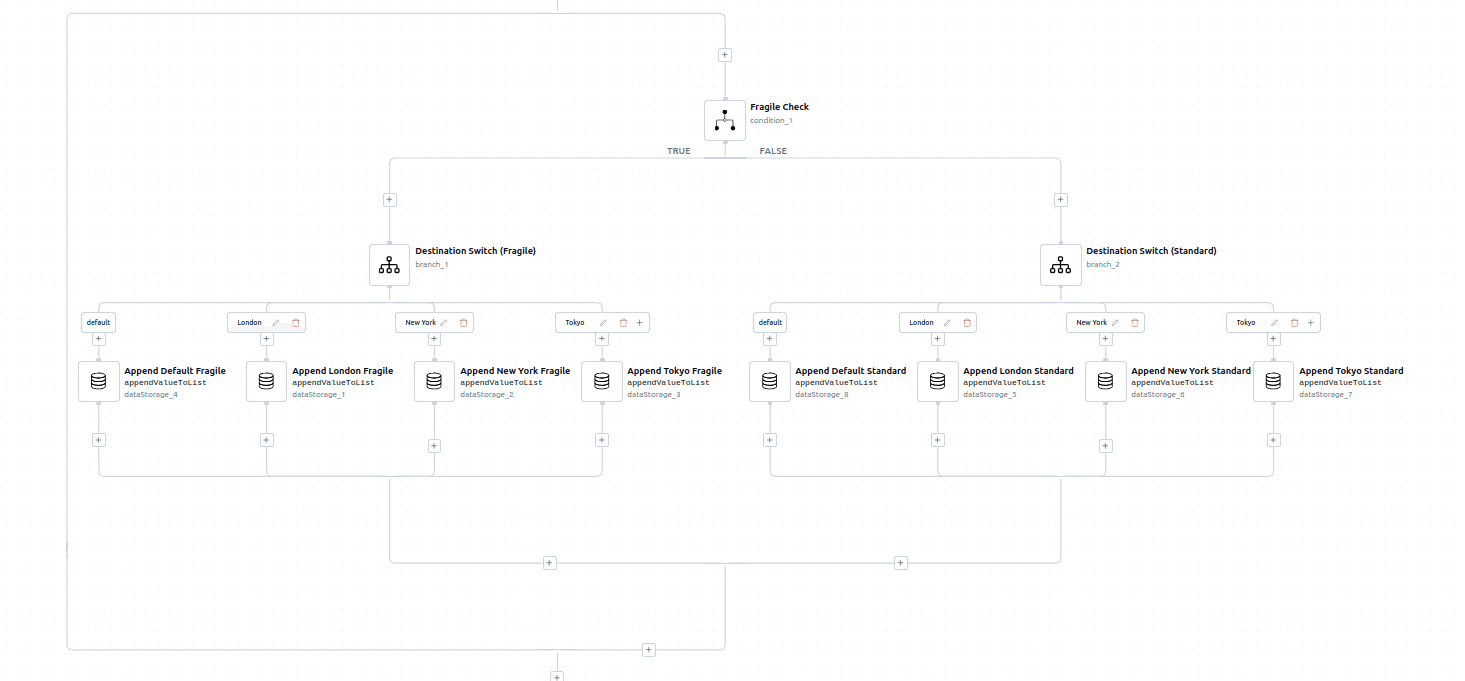
Visually, it even looked believable.
Logically, it was wrong.
That failure ended up teaching us a lot.
LLMs are surprisingly good at reconstructing workflow structure.
But preserving execution semantics across different workflow engines is much harder.
Especially when:
- branching behavior differs
- loops execute differently
- merges are implicit in one platform and explicit in another
- expression syntax changes
- task dispatchers behave differently
That’s where things get messy fast.
Hallucinations Were Very Real
We also hit the classic LLM problem constantly:
hallucinations.
One funny example was n8n’s “Edit Fields” node.
Instead of mapping the behavior to ByteChef’s "var" component, the model kept trying to find an “Edit Fields” component that simply does not exist in ByteChef.
Other times it generated invalid expressions like:
${var_1 == 0}
instead of:
${var_1} == 0
Small mistake.
Completely broken workflow.
And honestly, this is where a lot of AI workflow demos become misleading.
It’s very easy to generate something that looks convincing.
It’s much harder to generate something that is actually executable and semantically correct.
Most AI workflow demos hide how much validation and repair logic is happening behind the scenes.
The Prompt Became More Like a Runtime Protocol
One thing we learned pretty quickly:
generic prompting does not work for this problem.
The prompt evolved into this giant structured protocol with:
- workflow-building rules
- validation instructions
- graph construction constraints
- fallback strategies
- naming conventions
- hallucination prevention
- retry behavior
At some point it stopped feeling like prompt engineering and started feeling more like programming.
One instruction that ended up being surprisingly important was:
“Never ask the user any questions.”
That sounds minor, but it mattered a lot for the product experience.
We wanted the import flow to feel like:
- upload JSON
- click import
- done
Even if there’s a huge amount of complexity happening internally.
Because the second the system starts asking:
“What did you mean by this node?”
or
“Please resolve this mapping ambiguity”
…the illusion of seamless migration disappears immediately.
Validation Ended Up Being the Entire Game
The biggest thing we learned is that raw generation alone is nowhere near enough.
Validation is everything.
After generating a workflow, we validate:
- workflow structure
- task definitions
- expressions
- graph consistency
- outputs
- configuration correctness
If validation fails, we retry with corrections.
Retries improved results a lot more than we expected.
Without validation loops, the hallucinations pile up incredibly fast.
This completely changed how we think about AI-assisted workflow generation.
The common mistake people make with AI systems is assuming:
“If the model is smart enough, it will figure it out.”
In practice, workflow generation is much more of a constraint satisfaction problem than a creativity problem.
The AI is useful.
But the surrounding system is what makes it reliable.
What We Learned About AI Workflow Generation
One thing this project changed for us completely is how we think about AI-generated systems in production.
Early on, we had this vague assumption that if the model was “smart enough,” most of the hard problems would disappear automatically.
That turned out to be very wrong.
The workflows that succeeded consistently were not the ones where the model had the most freedom. They were the ones where the system around the model provided the strongest constraints.
That includes things like:
- validation loops
- task discovery rules
- naming conventions
- graph construction rules
- fallback strategies
- strict output formats
The model itself is only one piece of the system.
And honestly, that was probably the biggest engineering takeaway from the whole project.
The interesting part was not:
“Can an LLM generate workflow JSON?”
That part is relatively easy.
The hard part is building enough structure around the model that the generated workflow is actually usable.
Especially once you move beyond simple demos and start dealing with:
- branching
- loops
- dispatcher semantics
- unsupported nodes
- expression handling
- execution correctness
That’s also why we stopped thinking about this as “AI generating workflows” and started thinking about it more as:
“AI-assisted workflow interoperability.”
That framing feels much closer to the real problem we’re solving.
Because ultimately, users do not care whether the migration was powered by prompts, parsers, or deterministic mapping engines.
They care that they can move their workflows without rebuilding everything manually.
The Bigger Realization: Workflow Portability Matters
The deeper insight from this project actually has less to do with AI.
It’s about portability.
Right now, workflows are mostly trapped inside individual automation platforms.
And that becomes a problem once workflows stop being “small automations” and start becoming actual operational infrastructure.
Because at that point, rebuilding workflows manually is not just annoying.
It becomes organizational friction.
The real cost of workflow lock-in is not migration time.
It’s losing the ability to evolve your automation stack safely.
We think workflow interoperability is going to matter much more over the next few years.
Probably a lot more than the industry currently assumes.
Where We Think This Goes
Right now the copilot already handles a decent range of workflows:
- conditions
- loops
- merges
- branches
- email automation
- API-based workflows
But there’s still a lot left to improve.
The next step probably looks more like:
- deterministic translation layers
- graph-aware validation
- repair agents
- semantic workflow representations
- execution simulation
- iterative correction systems
The goal isn’t just:
“Generate workflow JSON with AI.”
The interesting problem is:
“Can workflows become portable across orchestration systems?”
That’s a much harder problem.
But also a much more important one.
And honestly, we think the industry is only at the beginning of that shift.
Conclusion
To summarize, this project started as a relatively simple idea:
make it easier for n8n users to migrate to ByteChef.
But along the way, it turned into something much more interesting.
We learned that LLMs are surprisingly capable at understanding workflow intent and reconstructing automation logic across different systems.
At the same time, we also learned that raw AI generation is nowhere near enough on its own.
The real engineering challenge is everything around the model:
- validation
- execution correctness
- graph semantics
- retry systems
- interoperability
- workflow reliability
More than anything, this project reinforced our belief that workflows should be portable.
Because once workflows become core operational infrastructure, rebuilding them manually every time you change platforms simply stops making sense.
AI won’t solve that problem completely by itself.
But it can make workflow interoperability dramatically more achievable than it was even a year ago.
Subscribe to the ByteChef Newsletter
Get the latest guides on complex automation, AI agents, and visual workflow best practices delivered to your inbox.